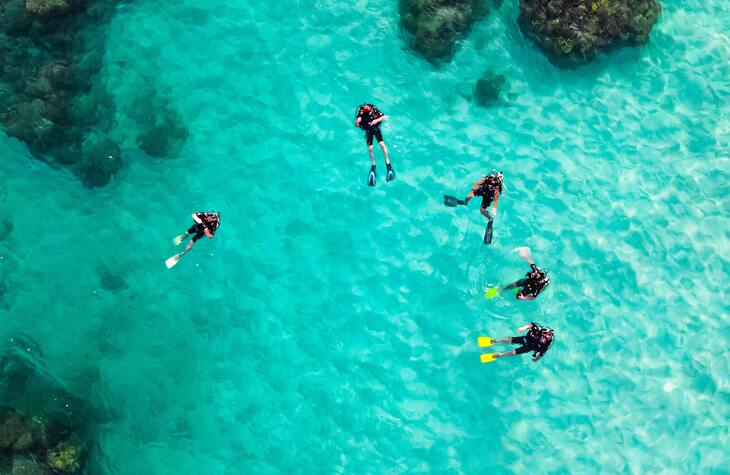
Dive into an adventure beneath the waves, where vibrant marine life, hidden tunnels, and ancient wrecks await exploration!
Costa Brava, stretching from Blanes to Portbou, emerges as a premier diving haven in the Mediterranean, boasting over 36 top-notch scuba facilities dotting its shores. Expect crystal-clear waters, comfortable temperatures, rugged coastlines, and a myriad of islands beckoning the intrepid explorer.
Eager to plunge in? Our guide, crafted from first-hand expertise, unveils the ultimate scoop on Costa Brava diving. From adrenaline-pumping hotspots to optimal dive times and essential certifications, we’ve got you covered. Keep delving to uncover the secrets!
Things to Know About Scuba Diving in Costa Brava
The prime season for diving in Costa Brava spans from May through October, when all centres are buzzing with activity. During these months, both air and water temperatures offer a delightful experience, sparing you from post-dive chills.
Even amidst the summer’s warmth, a full-body swimsuit remains essential. Our venture into Palamós for the Advanced Open Water course revealed water temperatures hovering around 17°C in the summer!
July and August mark the zenith of activity, with diving hubs bustling with enthusiasts. Advance reservations are strongly advised for those eyeing dives during these peak months.
Considering a winter plunge? Prepare for chillier waters ranging between 11 and 15°C, necessitating a dry suit. Be sure to verify winter operational hours, as some centres take seasonal breaks during the cooler months.
Certifications Needed to Scuba Dive in Costa Brava
In Costa Brava, diving mandates a license, unless you’re venturing for your inaugural dive or embarking on the Open Water course. Before plunging into the depths, centres will request your certification; hence, it’s prudent to store a digital copy on your phone.
Moreover, Spain, like much of Europe, mandates a dive medical certificate for certified divers or those pursuing certification courses. Compliance with this requirement is legally obligatory.
Price of Scuba Diving in Costa Brava
Scuba diving expenses in Costa Brava fluctuate based on location, diving facility, and whether a boat is required to access dive sites.
Typically, a guided dive ranges from €30 to €50. Equipment rental incurs additional costs.
Eyeing multiple dives? Inquire about centre promotions! Many centres extend discounted rates for subsequent dives.
What Marine Life Can You Spot on Costa Brava?
Costa Brava teems with a rich tapestry of marine life! Prepare to be captivated by an array of mollusks, starfish, sea urchins, and crustaceans, alongside bustling schools of fish. Venture to the Medes Islands for a chance encounter with majestic groupers.
Amongst the vibrant underwater world, nudibranchs steal the show with their kaleidoscope of hues and forms, while elusive seahorses and striking red and white gorgonians add to the spectacle.
But wait, there’s more! Keep your eyes peeled for larger inhabitants such as octopuses, congers, and moray eels, making occasional appearances amidst the underwater landscape.
And let’s not forget about the marine flora! Costa Brava boasts lush Neptune grass meadows, casting a verdant contrast against the sandy seafloor.
The Top Scuba Diving Sites in Costa Brava
Below are the premier diving locations in the region, from the southernmost to the northernmost:
Roca Muladera
Easily reachable from: Blanes, Lloret de Mar, and Tossa de Mar
Minimum certification required: Open Water
While Lloret de Mar is renowned as a vibrant party hub in Costa Brava, locals have another secret: its exceptional diving scene. Along its coastline lie numerous dive sites, with Roca Muladera, or Roca del Moro, standing out as a favourite.
This site boasts two seamounts separated by a channel, harbouring a diverse array of marine life. Encounter lobsters, moray eels, conger eels, schools of spits, and opisthobranchs, along with the occasional sighting of groupers.
Beyond the mesmerising fauna, the allure of Roca Muladera lies in its breathtaking scenery. The interplay of light through the channel creates a spectacle not to be missed.
Adding to its appeal, the depth ranges from 0 to 25 metres, catering to divers of all skill levels. Accessible by boat from Blanes or the enchanting mediaeval town of Tossa de Mar, this dive promises an unforgettable underwater adventure.
Illes Formigues
Easily reachable from: Palamós, Calella de Palafrugell, Llafranc, and Tamariu
Minimum certification required: Open Water
What appears as a mere rocky outcrop crowned with a lighthouse unfolds into a submerged utopia awaiting exploration! The Illes Formigues, or Ant Islands, comprise 16 islets teeming with marine life. Encounter moray eels, an array of nudibranchs, octopuses, and striking red and white gorgonians.
For photography enthusiasts, this site is a dream. The interplay of light amidst canyon walls is nothing short of mesmerising, offering moments of serene beauty.
Here, amidst the underwater world, you’ll be treated to the sight of Posidonia fields swaying gracefully with the ocean’s currents. Their emerald hues create a captivating spectacle, inviting admiration.
Venture through the labyrinth of holes, canyons, and crevices dotting the islands, ensuring every corner is explored for hidden treasures. Keep your senses sharp and embrace the wonders that lie beneath the surface!
Ullastres
Easily reachable from: Palamós, Calella de Palafrugell, Llafranc, Tamariu, and Begur
Minimum certification required: Open Water
Though we’ve yet to explore this dive site firsthand, glowing recommendations from friends have piqued our curiosity!
Meet the Ullastres: three majestic underwater pinnacles nestled just off the coast. Numbered consecutively from one to three, with the third standing as the outermost sentinel.
Begin your journey with Ullastres I, a gentle descent from 10 to 30 metres, offering a relaxed dive experience closest to the coast.
Venture deeper to Ullastres II, where depths range from 8 to 35 meters. Here, discover enchanting caves and narrow passages, adding an element of intrigue to your underwater exploration.
Ullastres III, the outer pinnacle, beckons with depths starting at 9 metres and plunging to an impressive 55 meters. Along its outer facade, facing the open sea, vibrant hues of red and green sea fans adorn the rocks, creating a kaleidoscope of colour.
Marvel at the abundance of bright red gorgonians adorning the walls while weaving through the channels and tunnels between the pinnacles—a visual feast for underwater photographers.
As you navigate this underwater realm, encounter the region’s characteristic fauna, from darting sardines to elusive conger eels and the occasional passage of barracuda schools.
Furió Fitó
Easily reachable from: Calella de Palafrugell, Llafranc, Tamariu, and Begur
Minimum certification required: Advanced Open Water
Nestled beneath the waves off the coast of Begur lies a hidden marvel: Furió Fitó, a colossal underwater rock formation teeming with Mediterranean wonders. Prepare to encounter a plethora of marine life, including lobsters, octopuses, moray, and conger eels lurking amidst the crevices.
The sheer walls of Furió Fitó are adorned with a vibrant tapestry of red gorgonians, sea sponges, and an array of invertebrates, transforming the rock into a majestic underwater mountain of colour.
With its base submerged at 56 metres and its peak reaching -14 metres, Furió Fitó presents an ideal playground for advanced divers seeking an exhilarating underwater adventure.
Canons de Tamariu
Easily reachable from: Palamós, Calella de Palafrugell, Llafranc, Tamariu, and Begur
Minimum certification required: Open Water
Dive into the enchanting Canons de Tamariu, where three parallel rocky bars converge to form two expansive canyons. Glide along these vibrant corridors, adorned with walls adorned in a kaleidoscope of colours, draped in gorgonians and tree sponges.
Yet, it’s not just the breathtaking landscape that captivates. The diversity of marine life thriving amidst the rocky outcrops is a sight to behold, with lobsters, groupers, and barracudas commonly gracing the scene. Keep your eyes peeled, for a stroke of luck might reveal the elusive presence of a ray or sunfish!
Expect unparalleled visibility in this underwater paradise, adding to the allure of the Canons de Tamariu.
Tips for scuba diving in Costa Brava
Before the dive
- Before embarking on your journey by plane, train, or car, ensure you have your diving license, medical certification, and diving insurance squared away. While diving insurance is optional, you can conveniently rent daily coverage at the diving centre.
- Consider bringing along your personal computer and mask, if available. While other equipment can be rented onsite, having these items of your own is advantageous.
- For those prone to seasickness, especially during boat dives, preemptive measures are key. Consider purchasing anti-nausea medication to mitigate any discomfort. Trust me, experiencing queasiness on the boat while gearing up for your dive isn’t anyone’s idea of fun!
During the dive
- Always prioritise safety, and never venture into scuba diving alone.
- Show the utmost respect for the local marine life. Keep a respectful distance from aquatic creatures, corals, and flora, refraining from disturbing them, even for the sake of capturing a photograph. Remember, we’re mere guests in their underwater realm, striving to ensure the flourishing of marine ecosystems!
And that concludes our guide! We trust you’re brimming with excitement to plunge into the vibrant waters of Costa Brava and embark on your underwater adventure. Have you heard of any other must-visit dive sites in the area?